Thursday, March 15, 2012

Baked Stuffed Potatoes with Corned Beef/Pâté


 I noticed on the jacket of the cookbook that among Melissa Clark's works are both The Deen Family Cookbook and The Skinny: How to Fit into Your Little Black Dress Forever. Hmmmm. To me, this recipe belongs more in the former category than the latter, especially the pâté version I made. At least I didn't use rillettes, which is basically shredded meat (at my butcher's, it's goose) preserved in its own fat. And it's true that these potatoes are not deep-fried.
Corned beef, which would have been leaner, is a speciality product only available from Jewish butchers here in France (as far as I know). I had planned a trip to Paris to buy corned beef and stock up on cocoa for brownies, but instead I went to a meeting. Much less productive.


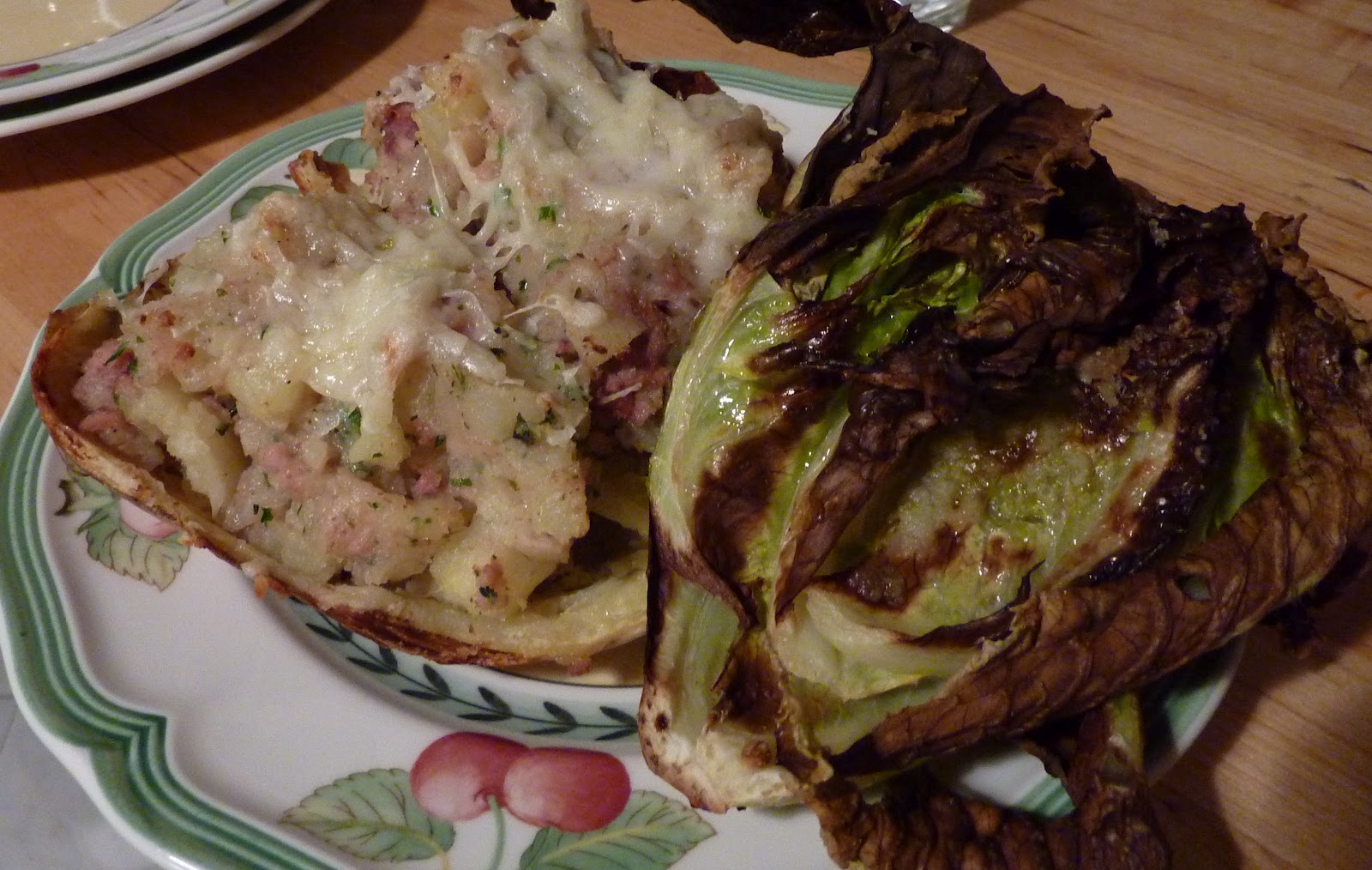
But what the heck. I decided that pâté (this was actually a "terrine au beaujolais") was the perfect locavore solution: my butcher's wife makes it. The recipe is basically a main-dish stuffed baked potato. You bake the potato after rubbing it in salt (a technique I hadn't tried before and was very pleased with, since I'm a potato-skin lover), and then you mash the flesh with butter, some herbs (I have a family of dill haters, so I went with my favorite herb blend) and some processed meat product (while listening to NPR tell you that processed meat will kill you. But they were talking about hot dogs, not "house-made" pâté. Right?). Then you pile that delicious mess into the potato skins, top with cheese (I used some leftover sheep cheese I had from our mountain trip), and throw them back into the oven or under the broiler until the cheese has melted/browned. I made a vegetarian version for Julia that involved sautéed mushrooms, and she loved it, even though she's not a big fan of the baked potato.


I served this with the Crispy Roasted Cabbage, which as you see was very crispy this time. Perhaps too much so. I believe the secret was that I used only one small head of cabbage for a large baking sheet, so it crisped rather than steamed. Only Julia and I ate the cabbage, which is fairly par for the course.
I was completely skeptical about the idea of putting pâté in a baked potato, but I really enjoyed it. In fact, I think I like pâté better in a baked potato than on bread. Heresy! The rest of the family enjoyed it as well: once again, no leftovers. I think if I did it again with pâté, I would add a bit of whole-grain mustard. But I'd love to try this with corned beef, because I do love corned beef. Someday.

Thursday, March 8, 2012

Chile-Coconut Short Ribs


When we returned from vacation last weekend, we had those post-vacation I-have-to-go-back-to-work/school blues. What better remedy than some comfort food in the form of braised beef in a tangy, spicy sauce?
So I went shopping for a few things: see my extremely fatty short ribs. My butcher asked me what I wanted to do with them, but I didn't want to shock him with the chile-coconut thing. Also, I'm not sure my French is up to describing this recipe. Especially considering that every time I order from the man, he screws up his face in intense concentration to understand what the crazy American lady wants now. Anyway, I just let him believe I was going to use the short ribs for a pot-au-feu or beef soup. That's why he gave me the marrow bone to the right: "to make the sauce more unctuous". Let me just say there was a lot of trimming involved, both before and after cooking.


And there is the cubed, trimmed meat (and marrow bone) in the pot with all the yummy aromatics: ginger, garlic, chile, lime. I only put in the juice and zest of one lime at the beginning of the cooking time, and I finished with the second lime when the meat was done. I think that freshened up the flavor. I also used a fat separator to degrease the sauce--it really needed it. Melissa may say that there's lots of "good fat" there, but I would like to respectfully disagree on that point.


I considered making the coconut rice and peas to go with the stew, as Melissa suggests, but that seemed like too much coconut for one meal. So I just made brown rice with peas. Claire objected to the rice being brown, but it was otherwise a nice accompaniment.
The verdict? The three of us who eat meat loved this. Once the meat was removed from the fat, it was fall-apart tender and delicious. And the sauce was just the right balance of spicy and tangy and sweet/creamy. There was none left after I had, ahem, cleaned the kitchen. It was a great way to ease back into the real world.

Sunday, March 4, 2012

Gingery Split Pea Soup


Let me begin this post with a travel tip: if you're leaving for a week-long trip to a fabulous mountainside apartment, you probably shouldn't pack your things at 5 AM with a raging fever. You'll probably forget a lot of random things, like sunscreen and long underwear and sharp knives. All this to say that although I cooked this soup in idyllic conditions (above is the view from the apartment we were loaned for the week), the cooking conditions were not exactly ideal.


If you've ever cooked in a vacation apartment, you'll know that the equipment furnished is generally sketchy at best. Dull knives are a given, and things like graters and peelers don't always exist. But I had remembered my cookbook and a bunch of important ingredients (though I also forgot a few), and I was determined to cook the soup and stay on schedule.


 So the vegetables got an, ahem, rough chop. This was kind of a problem for the ginger. I had brought my remaining red lentils, but they weren't enough. The minimart at the ski village where we were staying didn't stock split peas, but the kitchen we were staying in had green lentils, so I threw them in. And I had forgotten to bring rosemary and bay leaf, so I threw in some herbes de provence. Close enough, right? And I used a bouillon cube because it was there.


But check it out--I cooked the soup in a pressure cooker--probably one from the 70s. It scared me, but it did not in fact explode, and the soup cooked really quickly--by the time I had cleaned the kitchen and set the table, the soup was done. Such is also the nature of the vacation home kitchen--sometimes you have a pleasant surprise.
It was kind of fun to cook in this tiny kitchen, with the two-burner stove and tiny fridge and toaster oven. It was very similar to the kitchen I cooked in when I was a college student in Germany. Except I had better knives even back then.
And the soup? Well, it all got eaten--I'm beginning to really appreciate that about Melissa Clark's recipes. But no-one really went crazy over it. The ginger didn't get chopped finely enough (yes, that's the blame-avoiding passive right there), and so it dominated a bit much for my taste. The rosemary would have added a nice touch,  and I also think I would have liked the soup better with split peas. I guess to summarize, I wasn't thrilled with the soup as I made it, but I believe the soup as it was originally conceived would be really good. I'll have to try it again now that I once again have a clear head and a well-equipped kitchen.

Thursday, February 23, 2012

Crispy Roasted Cabbage


 So a couple of weeks ago, when I made this recipe, I went to the farmer's market to buy cabbage. It was a cold day and I felt bad about just buying cabbage, but then again, the money in my wallet was just enough to buy two cabbage halves. "How are you going to prepare it?" the vendor asked me. "Hot or cold?"
"Oh, hot. Roasted in the oven with olive oil. It's perfect for this winter weather!"
"Yeah, Germans like their cabbage warm, don't they?" he winked at me. I had to giggle inwardly. My French does come with rather a German accent,  I must say. And the fact that have brought this vendor some rather German pastries probably sealed the deal.


 But I didn't make this cabbage to go with German food--that night, I was going farther East to Poland. My friend Gabrielle and her daughter Pauline came over and we celebrated winter with eggplant caviar over Vollkornbrot, meat-filled pierogi topped with butter and caramelized onions, and this cabbage. And salad and dessert. The pierogi--which I would characterize as Polish potstickers--were a project (both Claire and Gabrielle helped me crank them out), but they were totally worth it.


And how was the cabbage? It was sweet and nutty, with the more bitter roasted edges playing off against the softness of the less-exposed areas. It complemented the pierogi really well, but I can think of many other meals I could (and will!) serve it with. I imagine that it would go well with a fried egg and sriracha sauce, just like Molly's cabbage, also a favorite. Or Aleppo pepper. Julia just ate it for lunch with ramen. The possibilities are endless, which is good, since winter is long here and there will be a lot of this cabbage in my future.

Thursday, February 16, 2012

Fragrant Lentil Rice Soup


 When Michelle decided to change from the Valentine's cake to this lentil recipe, I had mixed feelings. I always love to bake, and I usually make something chocolate for Valentine's day. On the other hand, the recipe in the Melissa Clark cookbook involved buttercream--the kind with egg whites and three sticks of butter. I had been scheming about how to wiggle around that (a scheme involving cupcakes) when the change was made. And now we have lentils and rice and spinach. What better way to show your love than to cook a really delicious and healthy meal?


So there I was on a Monday night, facing the stove with tears streaming down my face. Four onions is a lot to chop! Three of them went in a pan to caramelize.


 I then turned my attention to the "soup" pot (this ended up more like a pilaf), sautéing onions with aromatics like garlic, ginger (family favorite!), bay leaf, and cinnamon stick. I added these "coral lentils", as the French call them, and some stock and water and let the lot simmer. Note that I should have added the rice at this time, even though I used plain basmati rice rather than the brown basmati Melissa calls for.


In the meantime, the onions continued to caramelize. Although I followed the recipe fairly closely, adding a bit more oil and cranking up the heat, the onions never achieved the "crispy" stage. They were still deliciously caramelized. I've had more luck using the oven to get crispy onions, though they very quickly go from crispy to carbonized.


 In the meantime, as Melissa suggests, I had been making paratha dough, and when the lentils and rice seemed almost done, I cooked up some parathas.


Mmm...flaky, buttery flatbread. I'm sure the whole-wheat flour totally makes up for all the butter in these.


Now that the paratha is almost ready, it's time to add the spinach. I decided to leave out the mint because I wasn't feeling it. I'm curious to see if others used it.


And here's the finished product. The spinach freshens up the whole affair and keeps it from being exclusively brown food: unfortunately, red lentils lose some of their pretty color in cooking. The flavor is aromatic without being spicy: I didn't love the cinnamon flavor and might try to dial back on that (maybe adding some cardamom instead) another time. I liked the pilaf texture and loved the caramelized onion topping. As with the parsnip soup, a squeeze of lemon (no limes to be found right now) brightened and enhanced the flavor a lot. Everyone seemed to enjoy this dish, and it was the perfect amount for four people.
Cook this now? If you'd like something healthy, somewhat exotic, and not too complicated to put together, I would say yes!

Friday, February 10, 2012

Creamy Parsnip and Leek Soup


 I think that of all of us in this blog group right now, I'm the only one living in a place with a climate remotely similar to that of Melissa Clark's New York. Exhibit A: the view out my window. It gets cold here! And so some soup is definitely in order.


Root vegetables are also definitely the way to go at this time of year here: they're about all that's seasonal. Having lived in California and in the South, I know they're somewhat of a novelty item. I remember the first time I cooked a parsnip (roasted with a bunch of other root vegetables with a beef pot roast thing that turned out to be absolutely delicious) in California. It was strange and hard to find.
Parsnips are now a trendy vegetable in France, whereas apparently about five years ago, they were completely unavailable and unheard of. When I buy them at the market, people still ask me how I cook them. Celery root, however, is a normal thing to buy. Stalk celery, which I dislike anyway, is harder to find.


Another great cold-weather ingredient: thyme. Despite the "big cold" of the last week or so (highs in the low 30s), my thyme (which I planted from a bunch I bought at the farmers market) is still hanging on in its little window box. My parsley will probably come back: it always does. This is about the extent of my garden these days.


So, to the recipe: you melt a nice-sized piece of butter in a big pot. I would like to say that this is one of my favorite things to see.

You add about 4 sliced leeks (just the white and pale green parts) that have been very, very carefully washed, and you sauté them down until they're starting to brown.


Then you add a giant pile of white: parsnip, celery root, potato.


You add some aromatics like thyme and bay leaf (and parsley and celery leaf if you've got them and feel like tying a bouquet garni) and some stock (I had some homemade stock left from another soup I'd made) or water, and you let that come to a boil and simmer for a while, until everything is soft and mushy.


In the meantime, you can deal with your bread. Here I have a true German Vollkornbrot that's been hanging around in my freezer since friends brought it back for me. Really delicious, but really hard to slice.


When Melissa said "pumpernickel croutons", I assumed she meant real croutons, the kind you bake with olive oil and garlic, not just toast rubbed with garlic. So even though she wrote the latter, I decided that I would cube my bread, toss it with a clove of garlic cut into about 4 pieces and about a tablespoon of oil, and bake it at 375 for about 10 minutes. It was a nice addition and made a good texture contrast.


OK, it's about 40 minutes later, and all of your vegetables have cooked through. Fish out the bay leaves and thyme (and any other herbs).


Get out your immersion blender and purée the mixture. If you're not like me and prefer actual soup to something like mashed potatoes, you'll probably want to add more water or broth (or even some dairy--I ended up adding some cream I had in the fridge) to make it a bit more liquid.


Serve it up topped with croutons, a drizzle of olive oil, and a sprinkling of red (Aleppo) pepper.

The verdict? Julia and I liked it a lot: it's got a mild, mellow flavor and warms and fills you up: perfect on a winter day. Claire and Sami both ate theirs without complaining (which is saying a lot for Sami) but without any praise, either. Everyone agreed that this was more like purée (French for mashed potatoes) than soup, but for most of us, that's a plus rather than a minus.
Cook this now? Is it cold where you are? Do you have easy access to root vegetables like parsnips? Do you love mashed potatoes? If the answers are yes, then do it!

Thursday, February 2, 2012

Buttery, Garlicky, Spicy Calamari

I'm very excited to write this first post for a new blog group I'm part of, Cook This Now Together, a group of friends and friends-of-friends cooking our way through Melissa Clark's Cook This Now! Please check the blogs on the sidebar to see the group's entertaining takes on the same recipe.
Let me briefly introduce myself: my name is Maria, and I'm a transplanted Californian who has been moved all over the US but now lives in the Paris suburbs, where I teach English and immerse myself as much as possible in the food culture. I cook mostly for my family: my husband Sami, who loves meat and dislikes vegetables and soup; my daughter Julia, who loves vegetables and soup but doesn't eat any meat or fish; and my younger daughter Claire, whose tastes seem to change on a daily basis but who generally dislikes fish. Still, I cook something different every day, and usually I can find a majority who will eat and even enjoy it.


So let's get to this first recipe, which Alicia chose: Buttery, Garlicky, Spicy Calamari with Israeli Couscous. As soon as I saw the title, my first thought was, "Do they have Israeli couscous in France?"


 Well, the answer is probably yes, but in the shops I went into, they didn't. So I decided to go ahead and use the whole wheat mini-macaroni I already had in my pantry. I toasted it a bit in the pot before adding water and salt--a trick I learned from Cook's Illustrated--and I think it was a good substitution.


My second thought was, "How do you say calamari in French? Can I buy it here?" I was pretty sure I could, but I'd never seen it because I'd never shopped for it. Before I cooked this dish, I had never bought, much less touched, raw calamari. Maybe the picture above can explain why...
Well, it was not available at the outdoor market when I went, but when I went by the fish counter of my local Monoprix, there it was, encornet. I didn't buy even close to the 1-1/2 pounds Melissa calls for--I just asked for two of the beasties, and the fish guy cleaned them for me.


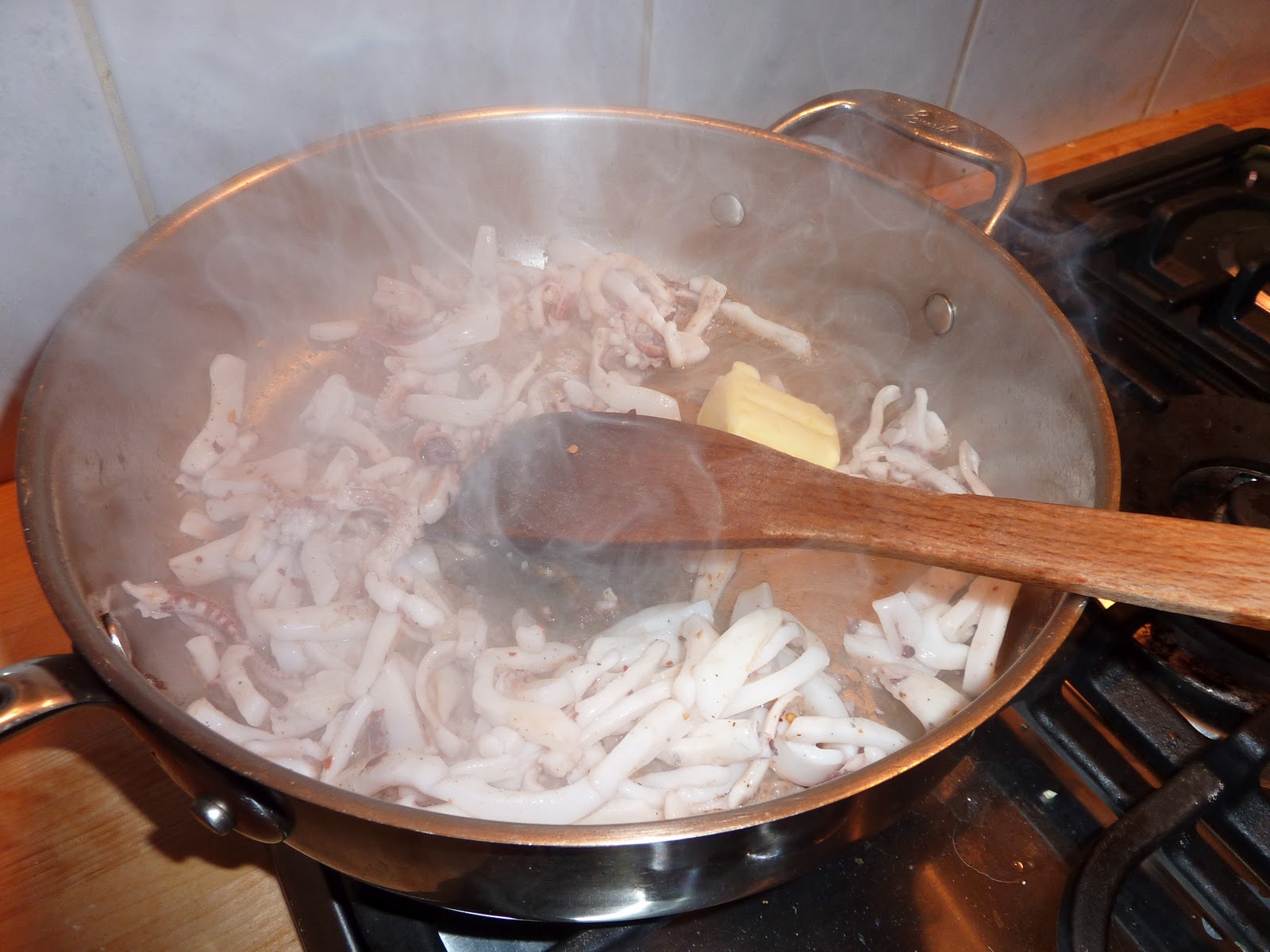
Once I had all the ingredients, this recipe was a snap. I made just a few tweaks to the procedure: since I don't like burnt garlic, I sautéed just the calamari and chiles first, and added the butter and garlic when the calamari was just about cooked. I then turned off the heat before adding the herbs (which were frozen and pre-chopped, because it's winter) and lime juice (oops, no lemons in the fridge).


I planned this recipe for a busy night: We had a meeting at the girls' school that night and didn't get home until 8. But Melissa writes that she considers this dish to be fast food, and indeed, wow, that was an understatement. With all the prep and even washing lettuce for a very basic salad, we were sitting down to dinner at 8:30 (a very normal dinnertime here in France). But the main appeal of this recipe in my eyes is that it's delicious. Claire, the fish skeptic, polished off a decent-sized serving without batting an eye. Julia snuck several bites of the pasta and declared it delicious. Sami went back for seconds, and also had the tiny bit leftover for lunch the next day, to my great disappointment (I had been hoping for some for my own lunch!).
So this was a great start to what I hope will be a fun, delicious, and educational adventure.