Friday, May 18, 2012

Rhubarb, Strawberry, and Lemon Marmalade


This recipe was a bit of a stretch for me in many ways, but I decided to just go for it. So last Friday night before I went to bed, I started making my first batch of jam ever.
Note that this French rhubarb, compared its German cousin from a couple of weeks back, is shorter and slimmer, and probably has more attitude.


 I trimmed and sliced the rhubarb and most of those two baskets of very ripe strawberries, added lemon and sugar, and left the mixture to sit out overnight to macerate.


The next morning, it was time to finish the jam. I started by straining all the sugary juices out of the fruit. 


There was quite a lot of it. The jam making process to this point rather reminded me of making a pie filling the Rose Levy Berenbaum way.


 In any case, the syrup went on the stove with a candy thermometer. When I noticed that the syrup was boiling and the thermometer only registered 200, I realized I'd probably want to add the fruit at about 220 rather than the 230 called for.


 It seems really smart to cook the syrup first and then add the fruit for just a short time for maximum flavor and texture. Of course, most people I know who make jam on a regular basis use pectin (here in Europe, they sell sugar with pectin mixed in so that it's super easy to make jam) and thus don't cook their jam quite as much.


 The jam boiled and boiled. I tried the frozen saucer trick, but even after 15 minutes, I wasn't seeing a wrinkle. I gave up and decided it was done.


I took a rather European approach to my jars: I used old jars that I had run through the dishwasher. My German host mother and my mother-in-law have done this for years and have never had problems. And there it was: my first batch of jam. It wasn't that difficult (besides the inaccurate thermometer problem, which is one that seems to haunt me) and may give me the courage to branch out and try other jams.


So here is my Sunday morning café au lait, croissant, and strawberry-rhubarb jam. I liked this jam: it was a bit sweeter than I would ideally have liked (even though I halved all the ingredients except the lemon) but has a fresh, balanced taste. When the others finally showed up at breakfast, I offered them some homemade jam. "Wow, you made this?" Julia asked. "But you don't even like strawberry jam!" It's true: I enjoyed the freezer strawberry jam that my mom made, but I generally object to cooked strawberries. So chalk this one up to my sheer determination to try a new family of recipes. I can't say I regret it. 

Friday, May 11, 2012

Pan-Roasted Pacific Halibut with Spring Onions


This was a pretty simple recipe based on the idea that spring onions are mild and delicious and match well with a nice piece of fish. Balsamic vinegar doesn't hurt, either.


I'm not sure whether what I got at the market truly qualifies as spring onions: we get these just about year-round. What's hard to find on the market here are actual scallions. But the "white onions" on the market now seem smaller and fresher than in other seasons, so I'll just believe that they're the right kind. Whatever these were, I dutifully trimmed them and cut them into quarters (halves for the smaller ones). Unlike Melissa, who claims she can cut hers tear-free, I had some eye irritation issues. No matter.


The onions then go in a skillet with olive oil and some salt, pepper, and thyme: first covered and then uncovered. As they cooked, I thought of the Slate article I had recently read about how long it really takes to caramelize onions (the author points the finger at Melissa Clark for underestimating the time it takes). Mine never really caramelized, but they got soft and nicely browned, so I decided to leave well enough alone.


So I deglazed the pan with balsamic vinegar and honey and had a sauce that was perfect for at least three of us: the girls and I love caramelized onions, and Claire has a special fondness for balsamic vinegar. Sami, however, is agnostic on the onion.


This part of the recipe was the downside for Julia and Claire: Julia doesn't eat fish, and Claire doesn't much like it, although I always make her try it. I went with the "colin" or haddock that I often use in fish dishes: I seared the skin side on the stove and put the skillet in a hot oven to finish for about 10 minutes or so.


And voilà: fish plated with onions and potatoes (fancy spring potatoes from Noirmontier). The portions were a bit small, but everyone liked the dish. Claire ate all her small piece of fish, because the onions helped it go down. Sami ate all his onions: perhaps the fish helped them go down, though he did in fact praise the sauce. Julia liked the sauce with her potatoes. And I liked it, too. It's a simple and elegant dish that really does highlight good ingredients, and it was light and flavorful. Now that spring seems to finally have arrived, this is the kind of food I want to eat more of!

Saturday, May 5, 2012

Roasted Asparagus with Gingered Rhubarb Sauce


One reason to cook through a book is to try out recipes that I wouldn't otherwise have tackled because of the technique or the ingredients or both. This recipe is an example of that: it involves asparagus, which I love, and rhubarb, which I don't. Note how the rhubarb is hulking in a dark corner in this picture, big and brooding, waiting to attack the poor delicate asparagus.


I don't love rhubarb because of its tart and bitter qualities. I always eat it when it's offered to me, but it's not my favorite. And then last spring I made a rhubarb crumble that made me reconsider my distaste for the vegetable. So I thought I'd give this recipe a shot.


It's a pretty simple process: you roast asparagus in the oven (I threw in a spring onion as well because I had one) while you brown butter and then sauté ginger, garlic, and rhubarb until the rhubarb breaks down. Then you add a few good squeezes of honey to balance out the tart rhubarb.


As Melissa Clark points out, rhubarb sauce is not pretty, but I don't think it's that hideous, either. We had this dish with macaroni and cheese, and I thought the big flavors of the sharp and spicy rhubarb asparagus balanced out the creamy pasta nicely. Claire wouldn't touch it because "rhubarb is overrated" (and she doesn't like asparagus either). Sami turned up his nose at the idea of rhubarb in a savory dish (and possibly rhubarb in general), but he tried it and decided he liked it: "It's like chutney." Yes, it is.
There were four of us at dinner and this small portion didn't get finished, so I can't really say the recipe was a raging success. But I thought it was a worthy experiment, and I enjoyed the leftovers (the sauce is excellent on roasted potatoes as well).

Lasagne with Turkey and Caramelized Onions

I found this recipe deep in my archives: it's one of the first recipes I typed on one of my first Macs. I didn't bother to write down where it's from, but my friend Google tells me it's from Sunset of April 1991. The recipe as written originally is designed to cut back on fat (low-fat being the trend of the day), despite the bacon. I added a bit of butter to make a béchamel rather than the cornstarch-thickened sauce they suggested. I also added some wine for additional flavor.

The resulting lasagne is delicious: it tastes nothing like a classic lasagne, of course, but more like Schwäbische Maultaschen, if you've ever had those. The onion and wine flavors dominate, while the meat and cheese add some richness. It's not a low-calorie dish by any means, but it's a bit more restrained than the kind of lasagne that involves two pounds of cheese and a creamy béchamel. And I imagine you could swap the meat out for some mushrooms to make it a vegetarian dish.

Here's my version of the recipe.

Lasagne with Roasted Onions, Turkey, and Thyme

1-1/2 lbs. red onions, peeled and sliced thin
4 oz. bacon, diced
2 large branches fresh thyme or 1 t. dried
1 lb. ground turkey or veal
3 T. balsamic vinegar
9 no-cook lasagne noodles
2 T. butter
2 T. flour
1/2 t. salt
1/4 t. pepper
1/4 t. nutmeg
1 c. milk
1 c. chicken broth
1/2 c. dry white wine, vermouth, or sherry plus some extra for the pan
1 bay leaf
4 oz. grated Parmesan (I used about 2 cups of grated cheese leftovers: Gouda, Cantal, and Parmesan)

Heat the oven to 400. Toss together the onions and bacon with some salt and pepper on a baking sheet or baking dish that's just big enough to hold them (if it's too big, the onions are likely to burn). Roast, stirring every 15 minutes or so, about 35-50 minutes, or until well browned. Add the thyme and turkey and return to the oven for another 10 minutes or so, just until the turkey turns white. Add the vinegar and stir well, crumbling up the meat. Set aside. Turn the oven temperature down to 375.
While the onion part is cooking, make your béchamel: in a medium saucepan over medium heat, melt the butter. Add the flour, salt, pepper, and nutmeg; whisk for about a minute to cook the flour. Gradually pour in the milk, broth, wine, and bay leaf, whisking to avoid lumps. Heat and stir until the sauce is thickened. This is a fairly loose sauce: you need some extra liquid for the lasagne noodles. Remove the bay leaf when you're ready to assemble the lasagne.
To assemble the lasagne, generously butter a 9-inch square pan and sprinkle the bottom with 2-3 T. white wine. Put 3 lasagne noodles on the wine and top with half the meat/onion mixture, a third of the sauce, and a third of the cheese. Repeat the noodle/meat/sauce/cheese layers and finish with a layer of noodles, the rest of the sauce, and the rest of the cheese. Lay a square of parchment over the cheese, then cover the pan tightly with aluminum foil and bake for 25 minutes. Take off the foil and parchment and bake another 15-20 minutes, until the top is brown and the casserole is bubbling. If you can, wait 10 minutes before you serve the lasagne: it will be much easier to cut. Enjoy with a green salad or vegetable.

Wednesday, May 2, 2012

Vietnamese Grilled Steak and Cabbage Salad


One of Claire's favorite foods is stir-fry: the kind with well-marinated meat, a few vegetables, and a bit of sauce: Asian-American food at its finest. So when I saw this recipe come up, I knew it would be popular because of the marinade and the ingredients. Unfortunately, Claire was invited to a friend's house for dinner the night I was planning to make this recipe. "That's OK," she shrugged, "I'll eat it for breakfast the next day."


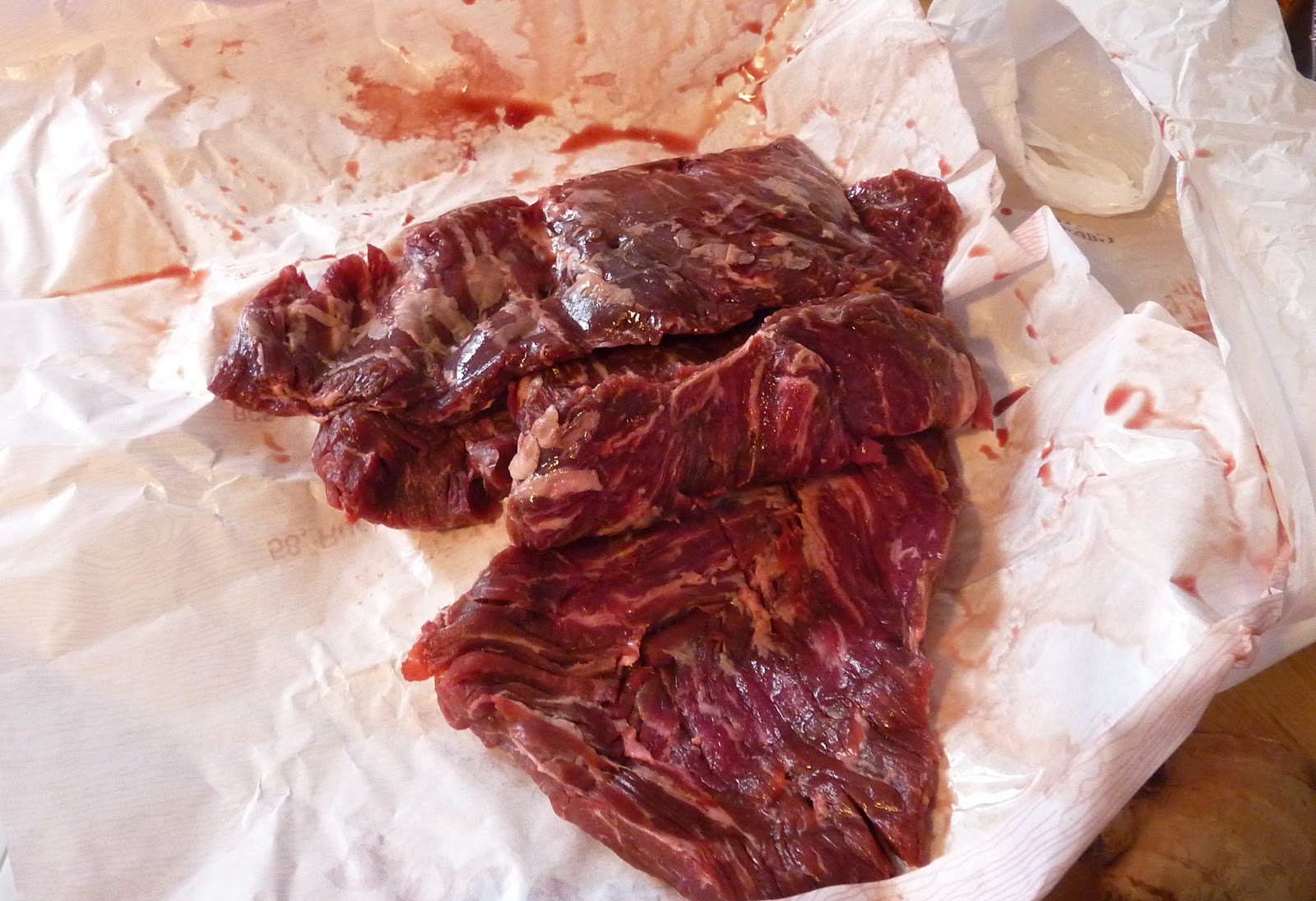
 Look at this beautiful meat.  It's "onglet" or hangar steak, lovingly prepared by my butcher. And though he probably would have shuddered in horror,  I went ahead and marinated it in soy sauce and lime and ginger and garlic and sesame oil, and then cut up my vegetables.


The green cabbage was not looking very appealing at the market last week, so red (purple!) cabbage it was. So I shredded the carrots and the cabbage, and then I went to bed with a nasty cold.


When I woke up, I could hear the sounds of cooking and laughter: our friend Jeannie was visiting, and she and Sami were trying to get the meal finished for me: neither one knew where much of the cookware or ingredients were, but they dug around and were eventually able to find everything they needed. Jeannie was concerned that she hadn't pressed the garlic as the recipe had directed, but I assured her that she had probably followed the recipe much better than I would have.
The steak was incredible: tender and flavorful. I wasn't quite so sold on the salad: the cabbage seemed awfully bitter. I had planned to add some frozen chopped mint and basil to the salad along with the cilantro, but I hadn't communicated that to the others--it might have helped. But Sami and Jeannie pronounced it "perfect", and Claire did in fact enjoy her breakfast steak and salad the next morning, while Jeannie had it for lunch. I might enjoy this even more as a classic stir-fry, with the cabbage and carrots cooked rather than raw. But it was definitely worth making, and very nice to have made for me.

Sunday, April 22, 2012

Pan-Roasted Asparagus


It's April near Paris, and you know what that means...cold, windy, rainy weather. I still wouldn't go so far as to call it the cruelest month. That would be November. But April also means the beginning of spring produce: strawberries, sorrel, peas, spring onions, asparagus.
Northern Europeans, however, seem to appreciate white asparagus more than the green stuff. I personally could never make friends with white asparagus: it requires peeling, and even then it can be stringy. So I was delighted to find beautiful green asparagus at a roadside market while we were on the return trip from vacation. 


This dish involves three basic elements: toasted breadcrumbs flavored with anchovy, lemon zest, and garlic; asparagus that's been roasted on the stovetop, and fried eggs that create a bit of a sauce and make the dish substantial enough for lunch.


The asparagus comes out of the pan somewhat toasty but also tender-crisp. However, I made the mistake of using the wrong kind of oil (the "good" olive oil, meant to be used as a finishing oil ) and overheating the pan: the asparagus picked up an unpleasant burnt-oil taste. I haven't had this problem roasting my asparagus in the oven, so I would recommend using a "normal" olive oil and the oven.


The bread crumbs were controversial: Claire immediately picked up on the fishy taste and was not happy about it. I thought it was kind of OK, but the dish would also have been good without the anchovy. Maybe even better.


And finally, the fried eggs. I picked up an awesome technique from Elle magazine: You can fry eggs in the oven! I put a bit of olive oil in my nonstick (oven-safe) skillet, cracked the eggs into it, and put the skillet in a 350 oven for 5 minutes--the eggs and asparagus started cooking at about the same time. They turned out great: the whites were completely set (which is normally a problem for me), but the yolks were still nice and runny.
I liked this dish, and I think it has the potential to be something I love. Changes I would make would be to roast the asparagus in the oven (since I would be turning it on for the eggs anyway) and to replace the anchovy with Parmesan. With those changes, I think it would make a perfect springtime lunch/brunch dish.

Saturday, April 21, 2012

Roasted Chicken Legs with Smoked Paprika


Once again I took Melissa Clark with me on vacation, and this time it turned out really well. Sadly, there is no photographic evidence of the meal, so let me show you where I cooked it.


This is the gîte, or vacation house, that our friend Nadine rented to celebrate her birthday with friends and family. It's in south-central France in a small town called Servas. The house was huge and gorgeous, and the location was also not too shabby.


We could look out our windows and see the hills and the small medieval towns and the olive orchards in the area. It was too cold to enjoy the pool, so instead we played a lot of card games and did some sightseeing and ate. And drank. And enjoyed being together in such a lovely place.


 Somehow I found myself spending a good deal of time in the kitchen, which was no hardship (especially since that got me out of most of the dishwashing). I had remembered my knives this time, and the equipment was otherwise really great. I cranked out a lot of "exotic" meals: pancakes (for Claire's birthday), couscous (because it feeds a crowd), scalloped potatoes with hot dogs on the side (again, Claire's special request), and the roasted chicken recipe.


 Many of the others at the house had never had pancakes or couscous before, but everyone was willing to give this strange food a try, and they all seemed to really like it. Therefore, I figured I could go ahead and fix the spicy chicken. There were two chickens, so I did one "classic" roast chicken with mustard and butter, and then I had Sami butterfly the other chicken (with many exclamations of awe and surprise from the others) so that I could marinate it in the strange ingredients I had brought. Ginger, chili, smoked paprika, cilantro: these are all still not an everyday part of the French pantry, and when I combined them with orange, salt, and olive oil, everyone seemed a bit skeptical. Especially when I sliced in about three chiles, realizing that they had no heat at all.
So the chickens went in the oven, the wine for the evening was opened, the snacks came out, and we played some cards while the chicken roasted. Once Sami had carved the chickens and we had brought them out with the leftover couscous, the taste testing began. Everyone wanted to try the "strange" chicken, and they all seemed to like it a lot--there was none left. What amused me, though, was that our American friend Jean preferred the classic French-style chicken while Nadine's French mother, who had been the most skeptical of all about my cooking decided that the "spicy" chicken was more to her liking.
In any case, this recipe was quite a success. It's sweet and a little spicy (your results will vary depending on the chiles you use) and very flavorful, without one flavor dominating. And while it would (and will) make a great weeknight dinner, for me it's now all about sitting around a giant table with a lot of good people, relaxing and enjoying life.